
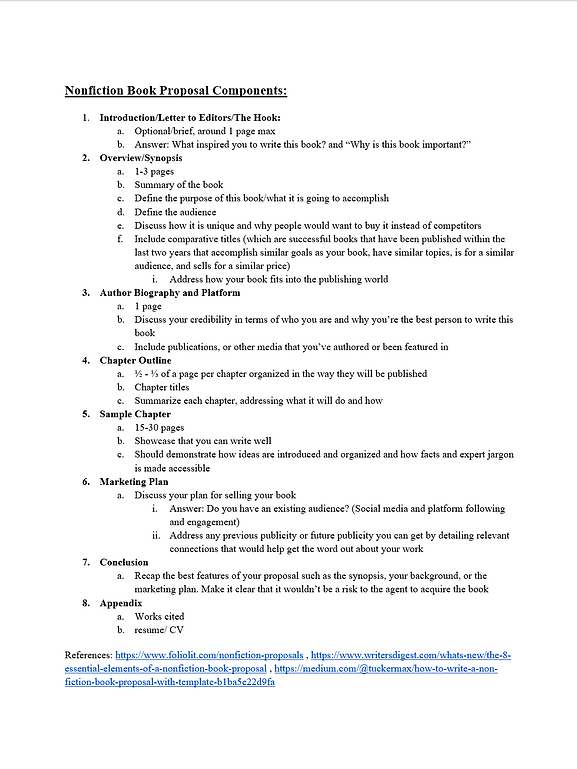
As a Student Editor at DePaul, I edited a Psychology Book Proposal on Word using track changes for Dr. Justine Stewart. After editing, I composed a summative memo outlining the changes and met with her on zoom to discuss her next steps. Her goal is to complete the proposal and have it ready to query. To help her format her document, I used my knowledge of the publishing industry alongside with additional research on how to write a nonfiction book proposal and made an outline that she can reference. Please click on the Word document to see my track changes and comments.
Nonfiction Book Proposal Outline
Summative Email
Edits
To: Justine Stewart (Justine.Stewart@my.wheaton.edu)
From: Olivia Borowiak
Subject: Summary of Edits for Psychology Book Proposal
Dear Dr. Stewart,
Your proposal for WHAT HAPPENS ON THE COUCH, a book that plans to demystify therapy, is in a good position for you to expand and revise before it is ready to query literary agents. I see your book fitting into a topical nonfiction book imprint marketed towards an audience consisting of therapy novices, skeptics, and existing inquisitive clients. With the goal of making your proposal query-ready, I edited for standard form of nonfiction book proposals, what POV would best serve your purposes and audience, paragraph organization using coherence and cohesion, and suggestions for ways you can expand on your existing ideas.
The form and structure of the proposal is the most important edit that I made to your document because agents are looking for proposals that signal that the author understands traditional publishing, and the first aspect of demonstrating understanding is the inclusion of necessary components and their organization within the document. I compiled an outline for you to use to reorganize the form of your proposal after researching and reading nonfiction book proposals. Attached to this email is a document outlining the components of a standard nonfiction book proposal. I arranged them in their most suggested order and provided context about their components. Briefly, they are Introduction/Letter to Editors/The Hook, Overview/Synopsis, Author Biography and Platform, Chapter Outline, Sample Chapter, Marketing Plan, Conclusion.
Another aspect of your proposal that I edited was the POV of both the proposal and the book itself to build trust between your audience and yourself. I propose that for both the proposal and book you use first person for the introduction, second person for the chapter titles/myths, and then third person for the body of each section. I chose first person for the introduction because it situates the audience close to you as a person who is passionate about clinical therapy and provides context that you are qualified to educate your readers. Then, I chose second person for the chapter titles/myths to convey the reader’s close relationship with the myth. For example, I revised one of the titles to say, “Your Therapist is Your Life Coach.” In this instance, the reader is the “you,” and puts them in a position to be demystified by the facts in the body of the chapter. I chose third for the body of each section for consistency, author ethos, and fact-based evidence. It is important to the goal of the book to be credible, and third person is a good choice for eliminating opinion and bias as you attempt to disprove myths with valid psychological research and studies from important scholars.
Strengthening your proposal by improving paragraph organization using coherence and cohesion. One trend I noticed in your proposal was the lack of topic sentences in each section and a lack of idea unification. To organize your paragraphs more successfully, I suggest defining a main idea, reviewing each contribution, and deciding if it builds on the main idea. If it does not, you can either make it into a new section, or delete it as unnecessary. Paragraph organization is important because you want to reduce the agent’s (and later the publisher’s) risk in investment by showing you’re capable of completing a well-written book and that your book will sell.
And finally, for each myth and component, I provided questions and offered opinions on ideas that you can expand on to complete your proposal with more detail and specificity. For instance, for myth #6, I think it would be a good idea to elaborate on the different types of therapy and the different types of training therapists have gone through and how those disprove the myth that there is one therapeutic technique that works.
The first step you should take to prepare your proposal for querying would be to read through my comments on your document. There are quite a few, so if you have questions, feel free to reach out. Additionally, you should consider my suggestions about POV, looking at my changes as an example of how the revised POV would function in the proposal. The next thing I recommend doing is compiling and organizing enough research to write at least a half-a-page summary that will debunk the myths and allow you to expand on the great ideas that already exist in your proposal now. The last task you should do is to reorganize paragraphs focusing on coherence and cohesion. Overall, you’re in a good place to begin completing your proposal, and I hope my feedback will give you a road map to help you achieve your goal of publishing!
Sincerely,
Olivia Borowiak
.png)
Download